

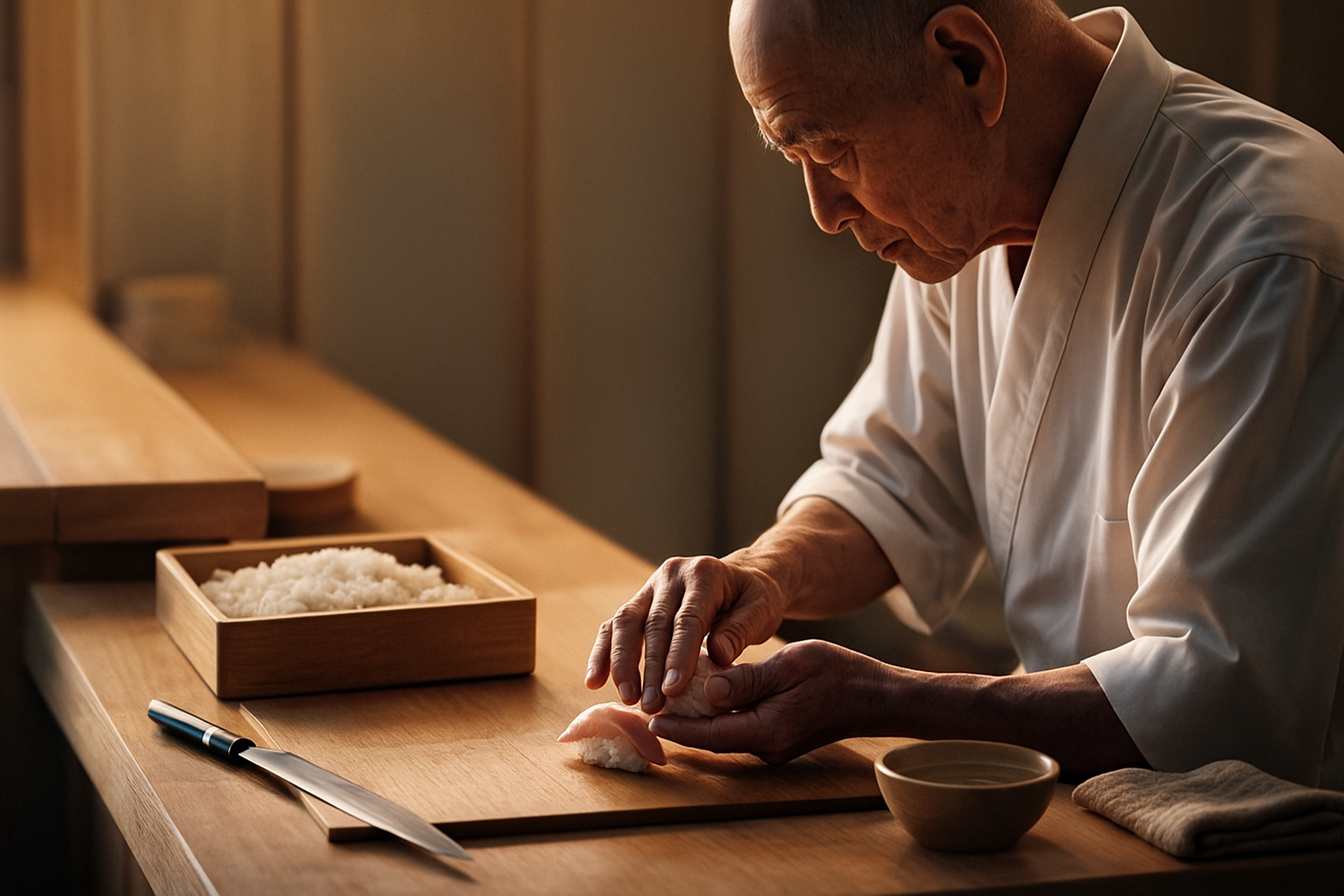
Jiro Ono’s story begins far from polished counters and pristine cuts of fish. He was born in 1925 in rural Shizuoka Prefecture, a place where survival depended on grit. His childhood unfolded during a period of deep poverty across Japan. Money was scarce. Opportunities were narrower. Every day demanded resilience.
By age 7, Jiro was already working. It was not a part time chore or a short shift after school. It was labor meant to keep him afloat. Two years later he had effectively left home. There was no soft landing. No safety net. He later reflected on that moment with a simple truth. He said he had no home to return to, so he kept working.
This early separation shaped everything that came after. Work became identity. Discipline became necessity. And the idea that mastery grows from repetition took root in those years of survival. Jiro learned that when life gives you no margin for error, consistency becomes a way of staying alive. That mindset never left him.
Jiro’s introduction to sushi came through a chance connection. A customer from his hometown led him to a sushi restaurant in Tokyo. It was an unfamiliar world, but it offered one thing that mattered most. It offered work.
He moved to Tokyo as a young boy and stepped into a kitchen where apprenticeships were not a romantic idea. They were a test of endurance. His days stretched long. The tasks were repetitive. And the rules were simple. No shortcuts.
For years he cleaned. He prepared rice. He observed the senior chefs with the intensity of someone who knew he had everything to gain from mastering the basics. He was not allowed to touch fish until he had earned that right. The entire apprenticeship system was designed to filter out anyone without the discipline to withstand monotony.
By 25, after nearly two decades in kitchens, he became a certified sushi chef. His early career included time across several restaurants, including a formative period in Osaka. Each stop sharpened his technique. Each day added another layer of skill. He absorbed everything. Temperature. Texture. Knife control. The subtle timing of movements. He was building a foundation for a life defined by craft.
In 1965, Jiro opened a small sushi bar in Tokyo’s Ginza district. It had only ten seats. There was no design to speak of. No attempt to entertain guests. No decoration meant to distract from the food. It was a workshop disguised as a restaurant.
Sukiyabashi Jiro became the space where Jiro worked out his deepest ideas about mastery. It was his laboratory. His classroom. His lifelong project. Every detail mattered. Every motion had purpose. He built his reputation on uncompromising quality. He refused to chase trends. He chose tradition because he believed fundamentals were where greatness lived.
The restaurant’s menu stayed simple. Its operation stayed consistent. And its standards rose year after year. For decades, it became known as the purest expression of Edo-style sushi anywhere in the world. People did not come for variety or flash. They came for precision. They came for truth in food.
In 2007, Sukiyabashi Jiro earned three Michelin stars. It was the first sushi restaurant to receive that honor. With that recognition came international attention. Chefs, world leaders, and devoted food lovers made the pilgrimage to the tiny counter in Ginza.
The omakase experience lasted only fifteen to twenty minutes. The meal consisted of roughly twenty pieces. The cost was high. And yet people waited months for a reservation. What they were paying for was not time. They were paying for distilled experience. They were paying for a lifetime of repetition performed at the highest level.
When the documentary Jiro Dreams of Sushi released in 2011, his philosophy reached a global audience. His way of thinking resonated far beyond the world of food. Founders, artists, athletes, and leaders saw in him the blueprint for mastery. He became a cultural icon not because of fame, but because of discipline.
Jiro represents the purest definition of shokunin, the craftsman’s spirit. His work demonstrates a devotion that does not rely on inspiration. It relies on commitment. He believes in falling in love with work, not waiting for passion to appear. He insists that improvement never ends. Even at an age when many retire, he said he had not reached perfection.
His practice reveals a few core beliefs. Skills do not come from talent. They come from repetition. Movements should become so consistent that deviation feels unnatural. Mastery hides inside the smallest details. The right pressure of the hand. The perfect contrast between warm rice and cool fish. The ability to remove everything unnecessary until only truth remains.
Simplicity, in Jiro’s hands, becomes art. His approach shows that consistency is not boring. It is liberating. It clears the noise so excellence can emerge.
Jiro’s workday looks simple on the surface, but every part of it is crafted with precision. Ingredient selection starts long before he steps into the restaurant. He works with trusted buyers who have known him for decades. They understand the exact standards he expects. They know what he will accept and what he will reject without hesitation.
He pays close attention to temperature. The fish must be stored correctly. The rice must be cooked and seasoned with absolute accuracy. Timing is central to everything. Each piece is served at the moment when flavor peaks.
The final product is shaped by muscle memory developed over more than eight decades. Every piece of sushi is the sum of thousands of repetitions. It is the result of movements refined until they cannot be improved any further.
Even as he grew older, Jiro continued to work. His presence in the restaurant remained constant. He believed that improvement is possible at any age. For him, mastery is not a destination. It is a direction. It is a mountain with no summit.
Jiro’s impact extends through the apprentices he trained. Many spent close to ten years before they were trusted with basic tasks. Patience was the price of entry. Learning came from repetition, not instruction.
His sons eventually became leaders in their own right. Yoshikazu Ono, his eldest, runs the original Sukiyabashi Jiro. Takashi Ono leads the Roppongi Hills location. They carry the same expectation for quality and the same respect for the discipline their father built his life around.
Jiro’s legacy is not technological or trend driven. It is generational. It shows that greatness can come from working quietly, carefully, and consistently. His influence proves that a single individual, committed fully to their craft, can reshape an entire industry.
Entrepreneurs around the world admire Jiro for one reason. His life is a case study in the power of focus. He did not diversify. He did not expand to dozens of locations. He mastered one thing. And he dedicated his life to doing it better every day.
His story teaches that hardship can sharpen you rather than break you. That small scale can be a strategic advantage. That devotion beats talent. And that mastery rarely looks glamorous. It looks like repetition.
His work reminds founders that simplicity wins when done at the highest level. When the fundamentals are strong, innovation grows naturally. When the craft is loved, improvement becomes automatic. And when the mission is clear, the work speaks for itself.
• Mastery grows from repetition
Excellence is built through daily practice. Do the small things consistently until they become instinct.
• Quality is a mindset
Tiny details separate good from legendary. Treat every part of the process as important.
• Commit deeply to your craft
Devotion creates momentum. Passion follows commitment, not the other way around.
• Never believe you have arrived
Even at the peak of his career, Jiro kept improving. Growth never stops.
• Small scale can be a strength
A ten seat restaurant became the most respected sushi bar in the world by focusing on precision, not expansion.
• Hardship can fuel discipline
Jiro’s early poverty shaped his identity. Use adversity to sharpen your standards.
• Your work can be your mission
When you treat your craft as a calling, the results reflect that purpose.
If you want to explore more stories of extraordinary founders, visit the Famous Founders archive here:
https://hustlelife.net/famous-founders/

We're An Affiliate - We are reluctant to allow advertising on this blog, which we believe will spoil the user experience. Instead (so that we can continue sharing our knowledge and expanding our content), we have decided to include affiliate links for the products that we use and/or rate highly.