

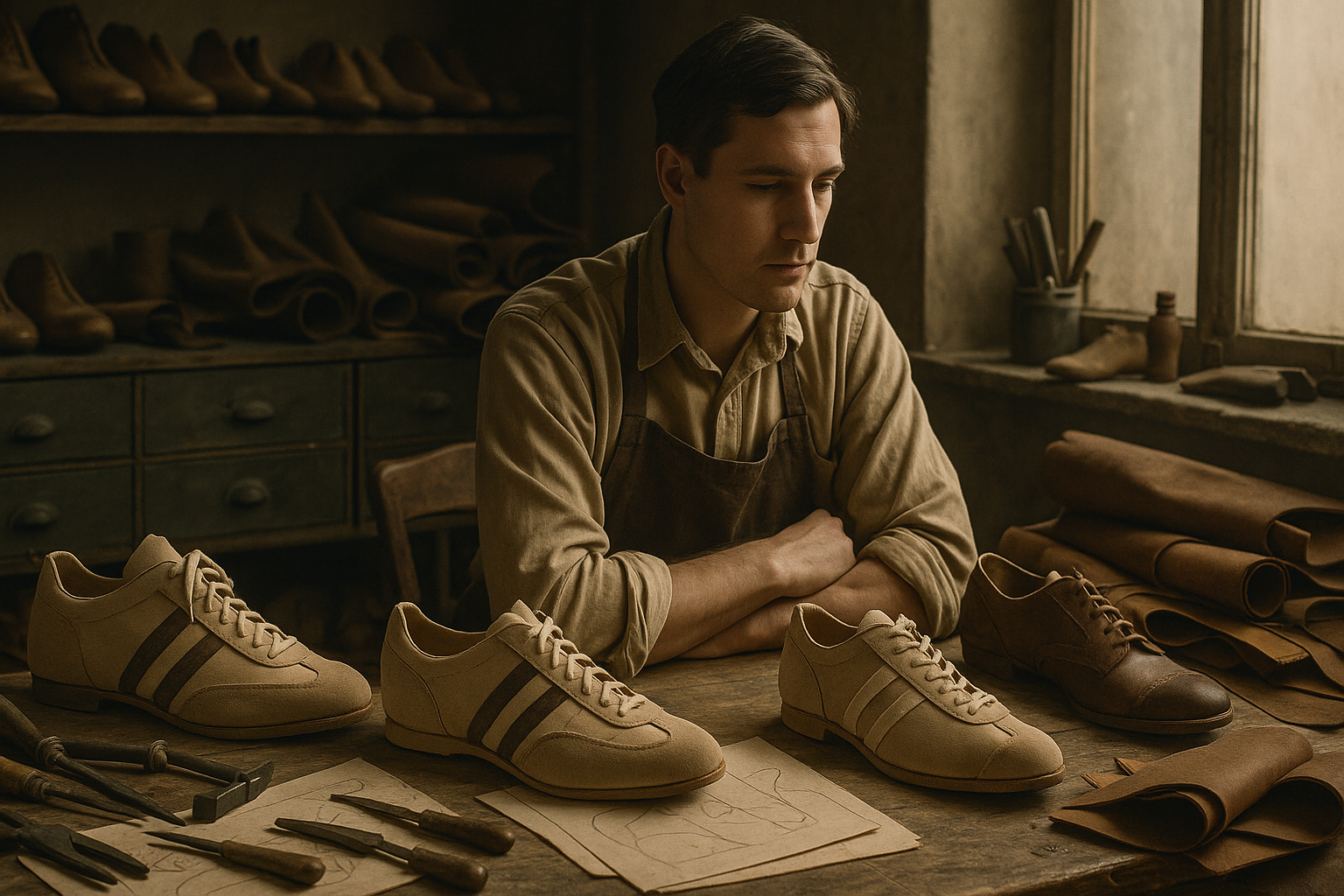
Every generation has a founder who proves that obsession, not noise, is the real engine of progress. For Adi Dassler, that obsession lived in a small washroom behind his mother’s laundry in the quiet town of Herzogenaurach. He was not loud. He was not social. He was not the type to chase attention. He simply wanted to make better shoes for athletes. That focus carried him through war, poverty, family conflict, political chaos, and the collapse of everything he had built. It also gave birth to one of the most influential sports brands in the world.
This is the story of how a shy cobbler became the mind behind Adidas, and how a life built on craft still shapes global sport today.
Adi Dassler grew up in a modest Bavarian household where nothing went to waste. His father was a shoemaker who often struggled to find steady work. His mother ran a laundry to keep the family afloat. Money was scarce, but the tools of a trade were always within reach. As a boy, Adi took scraps of leather and stitched them into simple footwear. He cared more about the fit than the look, which would become a lifelong pattern.
World War I interrupted everything. Adi was drafted as a teenager. The experience left him quiet and guarded, but it also reinforced a lesson he already knew. When the world turns upside down, a person must rely on skill. Not promises. Not titles. Skill.
After the war, Germany was in economic ruin. Inflation crushed daily life. Jobs disappeared. Yet in that washroom behind his mother’s laundry, Adi decided to focus on something he could control. He would make lightweight shoes for athletes. He believed that performance gear should be built, not bought in bulk. That idea put him decades ahead of the global sports industry to come.
Adi’s early workshop was as humble as it gets. He salvaged old leather from discarded shoes. He used broken machinery repaired by hand. He shaped wooden molds himself. The lack of resources forced him to innovate. If he needed a new tool, he made it. If he needed a new technique, he trialed it on the spot.
Sports at the time had nothing to do with commerce. Competitions were small. Athletes purchased their own gear. There was no endorsement ecosystem. Yet Adi believed that athletes deserved equipment designed with intention. He visited local clubs, spoke to runners and football players, and asked detailed questions about how their feet moved during play. His shoes improved with each prototype. Word spread.
By 1924, his older brother Rudolf joined the business. They called it the Dassler Brothers Sports Shoe Factory. It started small, but the reputation grew quickly through one simple rule. If an athlete needed something custom, Adi would build it. No excuses.
The Dassler brothers could not have been more different. Adi was quiet, patient, and focused on craft. He kept notebooks filled with sketches and measurements. He spent nights refining cleats and testing materials. Rudolf, on the other hand, believed the world rewarded personality. He was bold and expressive. He built relationships easily and handled most of the sales and distribution.
The pairing worked for a while. Sales grew. Athletes began wearing Dassler shoes at regional and national competitions. The brothers expanded their factory and hired workers from the town.
But tension lived beneath the surface. Rudolf saw the future in marketing and relationships. Adi cared only about product quality. These differences would become fractures later, but during the early years they helped each other. When one had a blind spot, the other filled it.
As the 1930s unfolded, Germany changed rapidly. Daily life tightened under the Nazi regime. Entrepreneurs had to operate under new rules, new bureaucracies, and constant pressure. The Dassler factory was required to supply footwear for military training. Like many business owners of the time, the family was forced to navigate a political system that infiltrated every part of life. Membership in party organizations became common for survival. There is no evidence of ideological devotion on Adi’s part. It was a period defined by constraints, not choice.
The war that followed pushed the entire nation into hardship. When World War II intensified, the Dassler factory was seized for military production. Workers from the town were drafted. Materials disappeared. The business that Adi had spent two decades building was no longer in his control.
Entrepreneurs often imagine the worst case as a supply chain problem or a failed launch. Adi lived through something far harsher. He watched a life’s work crumble under a global conflict that no person could outrun.
Near the end of the war, the relationship between Adi and Rudolf disintegrated. Stress, suspicion, and conflicting goals pushed them past reconciliation. Each brother believed the other had placed the company at risk. Family members took sides. Herzogenaurach split socially between supporters of one brother or the other.
When peace finally arrived, Adi was forty six years old. The factory was damaged. The partnership was over. The country was in ruins. Most people would have given up. But Adi took the one skill that had carried him since childhood and rebuilt from scratch.
He renamed the company Adidas, combining the first syllables of his first and last name. He focused on exactly what he cared about. Product. Performance. Athletes.
This was not a rebrand. It was a restart.
Adidas needed a distinct identity. Rivals were growing, and the industry was no longer local. When Adi purchased a small Finnish sports brand that used three stripes for stability on the shoe’s upper, he saw more than a functional feature. He saw a signature.
The three stripes served two purposes. They reinforced the structure of the shoe and created instant recognition from a distance. It was simple. It was clear. It reflected the way he worked. Nothing decorative for the sake of decoration. Everything should serve the athlete.
As Adidas shoes began appearing at major competitions, the stripes became a reference point for performance. Athletes trusted the craftsmanship. Coaches started asking for them. The brand gained momentum not through marketing tricks but through use on the field.
The postwar economy grew quickly. Television broadcasts introduced global audiences to international competitions. Athletes became public figures. Federations gained influence. A new phenomenon emerged. Athletes realized that their visibility had value.
Requests for payments began quietly. A runner might ask for shoes in exchange for wearing the brand. A footballer might ask for cash. Sometimes it was formal. Sometimes it was not. Adi understood that influence had shifted, even if he did not fully embrace the change.
To reach new markets, Adidas had to negotiate, travel, and maintain networks across continents. Breaking into a country was slow. It required visits to clubs, meetings with coaches, and constant presence. Orders were small at first. Then they grew. There was no shortcut. Market by market. Team by team.
Adi’s strength was still the product. Rudolf, now running Puma, leaned harder into marketing. The rivalry between the two companies became legendary and sometimes petty. Each tried to outdo the other. The small town of Herzogenaurach split into Adidas families and Puma families. Even local shops aligned with one side.
While both companies fought for marginal advantages, a new competitor quietly rose in the United States. Phil Knight and his company Nike targeted running culture. Adidas executives dismissed it. They believed the demand for their shoes was already more than they could handle. No one considered jogging a serious sport. The opportunity floated in plain sight.
Founders often tell themselves that a new competitor is just a toy. History rarely agrees.
Adi Dassler cared about only one thing. Make the best possible shoe. Make it lighter. Make it fit better. Make it perform under pressure. He tested prototypes endlessly. He observed athletes closely. His staff often watched him study a player’s feet during practice with total concentration. He believed that someone’s performance revealed everything a designer needed to know.
He reminds many historians of Henry Royce, the cofounder of Rolls Royce. Both men shared the same near spiritual belief in craftsmanship. Both lived simply. Both trusted the work more than any marketing slogan.
Adi often said that a pair of shoes must serve the athlete’s mind as much as the athlete’s foot. If an athlete believed the shoe helped, it did. Confidence was part of performance.
Under his leadership, Adidas became the standard for football, track, and several Olympic sports. Entire generations of athletes built their careers wearing his designs.
As Adidas grew, the administrative burden grew with it. More employees, more distributors, more agents, and more bureaucracy pulled Adi away from the workshop. Success can sometimes push a founder away from the work that gave them energy in the first place.
At times, the company made him miserable. Decisions moved slowly. Factions emerged. The joy of craft was diluted by the structure required to run a global brand. Adi believed that somewhere along the line, he had lost the plot. The company carried his name, but the pressure of scale made it hard for him to focus on the thing he loved most.
This is a dilemma almost every founder faces. Growth expands opportunity but narrows daily control. The business becomes something different from what the founder intended. Adi understood this tension deeply. Yet he kept working, always returning to prototypes, materials, and movement.
It was his way of staying grounded.
Adi Dassler passed away in 1978, leaving behind a company that shaped modern sport. His fingerprints remain in every product line. Every design choice that favors function over flash traces back to him. Every conversation about athlete performance that begins with the shoe’s structure comes from his way of thinking.
His impact is not measured by slogans, endorsements, or noise. It is measured by the thousands of athletes who trusted his work and by the way Adidas set the standard for performance gear.
The story of Adidas is the story of a quiet craftsman who believed that quality speaks louder than personality. It is the story of a founder who lived through war, family division, political pressure, and fierce competition without losing his commitment to the athlete. It is a reminder that greatness often comes from the person in the corner of the workshop, stitching together an idea that no one else sees.
Adi Dassler proved that the world always has room for someone who refuses to cut corners.
• Build from skill, not noise
Adi started with craft. He mastered one thing until it became undeniable. Entrepreneurs who focus on a single strength gain a powerful foundation.
• Scarcity forces creativity
His early years shaped his mindset. When materials were limited, he improvised. Resource constraints can produce sharper thinking and better products.
• Know your customer deeply
Adi talked to athletes constantly. Every detail mattered. When founders study real user behavior, the right decisions become obvious.
• A brand grows one market at a time
Adidas expanded slowly. It required travel, conversations, and persistent presence. Breakthroughs often follow long periods of groundwork.
• Rivals can blind you to real threats
While Adidas and Puma obsessed over each other, Nike rose quietly. Entrepreneurs must watch the full field, not just their immediate competitor.
• Never lose the original purpose
When the administrative weight of Adidas pulled Adi away from the workshop, he felt the business draining him. Founders must protect the work that keeps them thriving.
• Consistency builds trust
Athletes relied on his shoes because he never compromised on quality. The same principle holds for any product. Reliability compounds over time.
• Obsession can be an advantage
Adi’s focus produced breakthroughs that generalists often overlook. Deep, sustained attention can shape an entire industry.
If you want to explore more stories of extraordinary founders, visit the Famous Founders archive here:
https://hustlelife.net/famous-founders/

We're An Affiliate - We are reluctant to allow advertising on this blog, which we believe will spoil the user experience. Instead (so that we can continue sharing our knowledge and expanding our content), we have decided to include affiliate links for the products that we use and/or rate highly.