

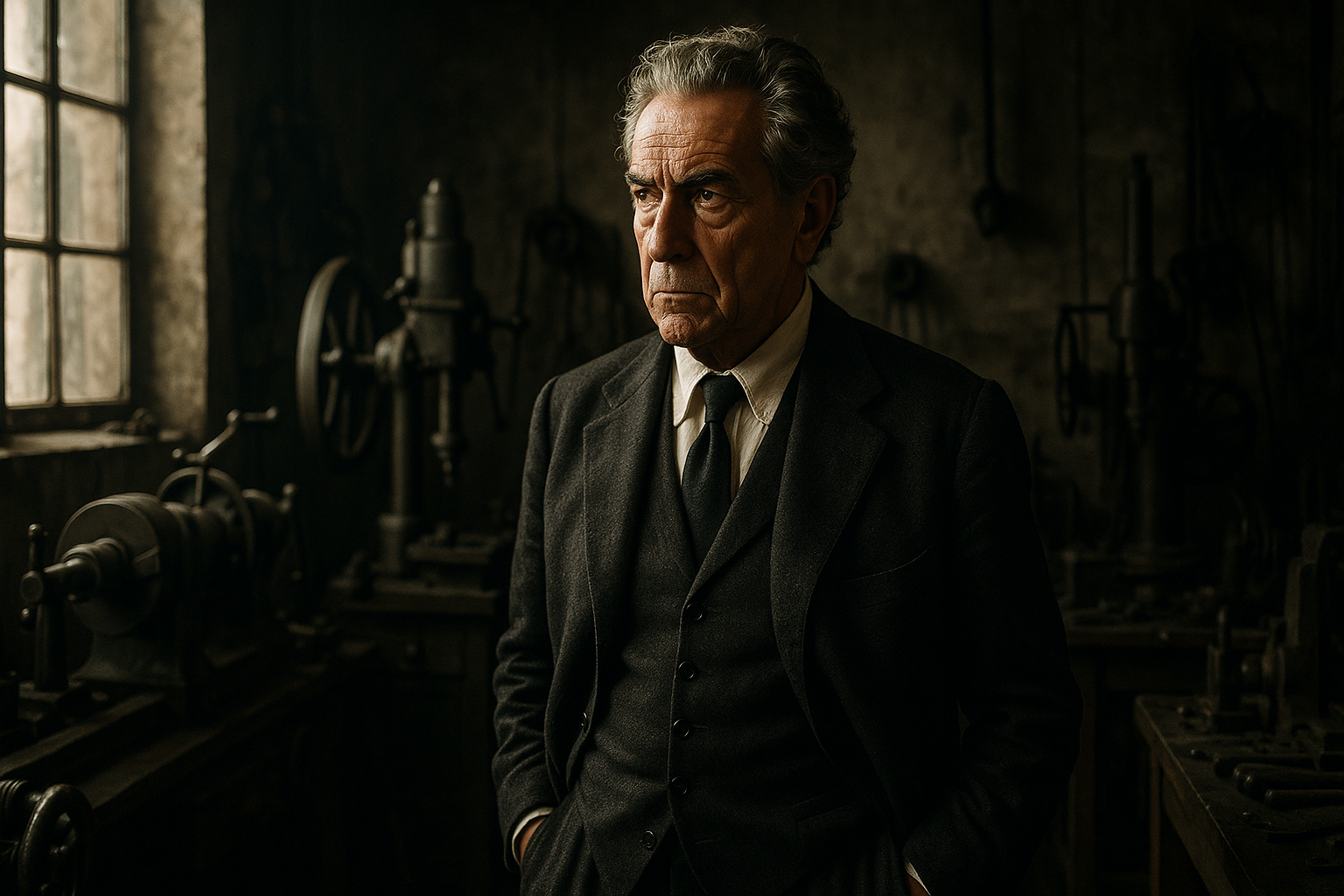
Enzo Ferrari spent his entire life chasing a feeling most people never touch. He wanted speed that frightened the driver. He wanted machines that seemed impossible, then proved their worth on the track in front of the world. He wanted a name that stood for perfection. And he never stopped pushing toward that goal, not for a single day.
The story of Enzo Ferrari is the story of extreme commitment. He built a company that became a global symbol of power, craft, and competition. Yet everything in his life pointed toward something simpler. He was a man who refused to live a quiet life. He wanted to become Ferrari.
This is the life of one of history’s greatest obsessives, a builder whose iron will shaped an industry and created one of the most admired companies in the world.
Enzo Anselmo Ferrari was born in Modena in 1898. His childhood was defined by modest conditions, limited options, and a father who introduced him to machines. His father ran a small metalworking shop, and Enzo grew up surrounded by tools, noise, and the rhythm of physical work. The environment taught him two things he carried forever. First, the power of craftsmanship. Second, that nothing great is built without effort.
His early years were marked by tragedy. Enzo lost both his father and brother within a short period. The losses came at a time when he was still trying to understand his place in the world. He later said, “I was back where I had started. No money, no experience, limited education. All I had was a passion to get somewhere.” That sentence captures the starting line of his life. He had no advantages. He had no assumption of success. He only had hunger.
He tried different paths before finding the one that would define him. He served in the military during World War I, suffered through illness, and then took a job wherever he could find one. Nothing fit. Nothing felt big enough. Eventually he found work as a driver for a small car manufacturer. That was the shift. He discovered the world that matched his ambition.
From that moment, everything changed.
Enzo began his racing career with Alfa Romeo in the early 1920s. At first he approached racing as a way to survive. Soon he recognized it as the perfect outlet for his competitive nature. Racing was a pure test. It punished weakness and rewarded speed, precision, and bravery. He understood quickly that the sport could define him, but not as a driver. His future was elsewhere.
Enzo was an average driver, but he was a brilliant thinker. He studied how races were won. He studied machines, men, and preparation. He studied the psychological pressure that separated winners from everyone else. His true talent was not driving. His talent was controlling the field around him. He later said, “I have never considered myself a designer or an inventor, but only one who gets things moving and keeps them running. My innate talent was for stirring up men.”
This was the theme of his career. Ferrari was an agitator, a motivator, and a master at unlocking performance in others. He found his place managing the Alfa Romeo racing team, and it became clear that he understood the sport on a deeper level. He knew how to inspire, intimidate, challenge, and direct strong personalities. He was not looking for docile workers. He wanted proud, competitive, difficult people. Those were the ones who built fast cars and drove them without fear.
Enzo discovered that his greatest skill was shaping a culture that demanded greatness. It was a lesson he carried for the rest of his life.
In 1929 Enzo founded Scuderia Ferrari, a racing team that partnered with Alfa Romeo. It started as a racing stable, not a car manufacturer. Yet even at this early stage, his ambition was clear. He wanted his name on cars built to win.
The relationship with Alfa Romeo eventually became restrictive. Enzo did not want to be a branch of someone else’s company. He wanted full control and full responsibility. When the partnership ended, he signed an agreement that prevented him from using the Ferrari name on cars for several years. During that period he created Auto Avio Costruzioni and worked quietly, waiting for the moment he could finally build cars under his own name.
The Second World War slowed everything, but Enzo refused to stop. When the war ended, he moved his operation to Maranello, rebuilt from almost nothing, and prepared for his true beginning. In 1947 the first car to carry the Ferrari name, the 125 S, left the factory gates.
That moment marked the start of a new era. Enzo Ferrari had become Ferrari.
Everything about Ferrari cars reflected the man behind them. “All masterpieces bespeaks the character of its creator” is one of the truest statements ever made about Enzo. His cars were bold, obsessive, and designed to win. They demanded disciplined engineering and intense craftsmanship. Nothing about them was casual.
He once said, “It is obvious that a Ferrari is the product of a sort of automotive watch-maker.” He valued precision. He valued the hands of artisans. He believed that a product was only as good as the pride inside the workshop that produced it. The people working on Ferrari cars used methods similar to those used to craft armor and royal carriages centuries earlier. Every detail mattered.
Enzo built cars for one primary reason. He built them to race. The purpose of the road car business was simple. Road cars funded the racing program. Racing created the legend that sold the road cars. It was a cycle only he could sustain because his willpower was unlike anyone else’s. He once said, “Everything that I have done, I did because I could not do anything less.”
He also had a unique philosophy about desire and scarcity. “A Ferrari must be desired,” he said. “It cannot and must not be perceived as something that is immediately available; otherwise, the dream is gone.” His understanding of psychology made him one of the strongest marketing minds in industrial history. He created a product that people wanted even more because they could not easily get it.
No part of Ferrari’s story stands out more than his leadership style. Enzo was not gentle. He was not nurturing. He worked with driven, ambitious people and pushed them hard. “Enzo Ferrari was the consummate manager of men, not docile, soft men, but proud, fiercely competitive, egocentric men.” That insight describes the environment he created.
He used rivalry inside the company to drive performance. He set high expectations and accepted no excuses. He believed that pressure produced results. He said he had the “stubborn determination to capture the trust of those who work with me.” And he earned that trust by demanding excellence from himself first.
Ferrari was a man of extreme discipline. He never took a vacation. He lived next to his factory, ate simple meals, and focused entirely on the work. He refused distractions because he believed his mission required total dedication. He once said he should not have married because a man with his passion could not divide himself in half. He was honest about the sacrifices he made.
His competition was not limited to business. It was personal. He wanted his cars to beat every rival. He wanted his team to dominate. He had a “diamond-hard will to win at all costs.” That quality shaped the identity of the Ferrari brand and defined its culture for generations.
Ferrari spent decades locked in intense rivalry with other manufacturers. Each battle strengthened the company. The most famous feud came with Ford in the 1960s after a failed acquisition attempt. Ford wanted to buy Ferrari. Enzo rejected the deal because it threatened his control over the racing division.
That decision triggered one of the most legendary competitions in automotive history. Ford committed to beating Ferrari at Le Mans. Enzo responded not with fear, but with a deeper commitment to victory. The rivalry produced stories that have defined motorsports for decades.
Enzo once said that racing was “a profession for men who do not wish to die in bed.” Speed was not just a measure of engineering. It was a measure of courage. And he demanded that courage from everyone associated with his cars.
He also had a simple rule for how his cars should feel. “When the driver steps on the gas I want him to shit his pants.” He wanted power that shocked people. He wanted a sensation that could not be forgotten. This was not marketing language. It was a philosophy. Fear and excitement were part of the experience he aimed to create.
Ferrari’s personal life was marked by tragedy. The death of his son Dino in 1956 crushed him in a way nothing else had. It hardened him even more. For the rest of his life he wore dark glasses and spent little time in public. He rarely left Maranello. His work became a shield against pain and a container for his obsession.
People who knew him often described him as lonely, guarded, and difficult. But they also described him as a man with enormous presence. He inspired loyalty, respect, and fear. His mind stayed focused on the same mission for nearly sixty years. “Win or lose, he unfailingly answered the bell.” That line captures the man completely.
His life was not balanced. He never pretended it was. He believed that great work required sacrifice. He lived according to that belief every day.
By the 1980s Ferrari was both a global luxury brand and a dominant force in motorsports. The company represented excellence, craftsmanship, and performance. It had become everything Enzo worked for.
He remained active until the very end of his life. He was involved in major decisions. He evaluated new cars. He pushed his teams. His passion never weakened. He once said, when asked about the reason for his obsession, “One day I want to build a car that is faster than all of them, and then I want to die.” It was an honest reflection of his purpose. He lived long enough to see his company become an icon.
Enzo Ferrari died in 1988 at ninety years old. When asked how he wanted to be remembered, he said, “As someone who dreamt of becoming Ferrari.” That answer reveals everything. He spent his life building something greater than himself. The brand was not a symbol. It was the physical expression of his ambition.
His legacy is not only the company he built, but the standard he set. Ferrari is a symbol of desire, excellence, and relentless pursuit. It stands today as a reminder of what happens when a founder refuses to lower the bar.
1. Build with obsession, not convenience
Enzo Ferrari did not create a balanced life. He created a legendary company. His extreme focus demonstrates that big outcomes demand big sacrifices.
2. Culture determines performance
Ferrari built a culture filled with pride, rivalry, and personal responsibility. He understood that people rise or fall based on the environment around them.
3. Scarcity strengthens desire
Enzo used limited supply, craftsmanship, and exclusivity to increase demand. He recognized early that a great product must also be positioned as a dream.
4. Control is a competitive advantage
He refused deals that threatened his autonomy. He knew that control allows a founder to protect the mission and maintain quality.
5. Pressure can unlock excellence
Ferrari believed pressure was necessary for greatness. He demanded high standards and accepted nothing less.
6. Identity shapes products
His cars carried his personality. They were bold, fast, and uncompromising. Entrepreneurs should build products that reflect their own convictions.
7. Marketing is not decoration. It is strategy
Ferrari mastered the art of showmanship. He understood that the story around a product can be as powerful as the product itself.
8. Winning is a mindset, not an accident
He approached every challenge with the intention to dominate. That mindset allowed a small factory in Italy to become a world leader.
If you want to explore more stories of extraordinary founders, visit the Famous Founders archive here:
https://hustlelife.net/famous-founders/

We're An Affiliate - We are reluctant to allow advertising on this blog, which we believe will spoil the user experience. Instead (so that we can continue sharing our knowledge and expanding our content), we have decided to include affiliate links for the products that we use and/or rate highly.