

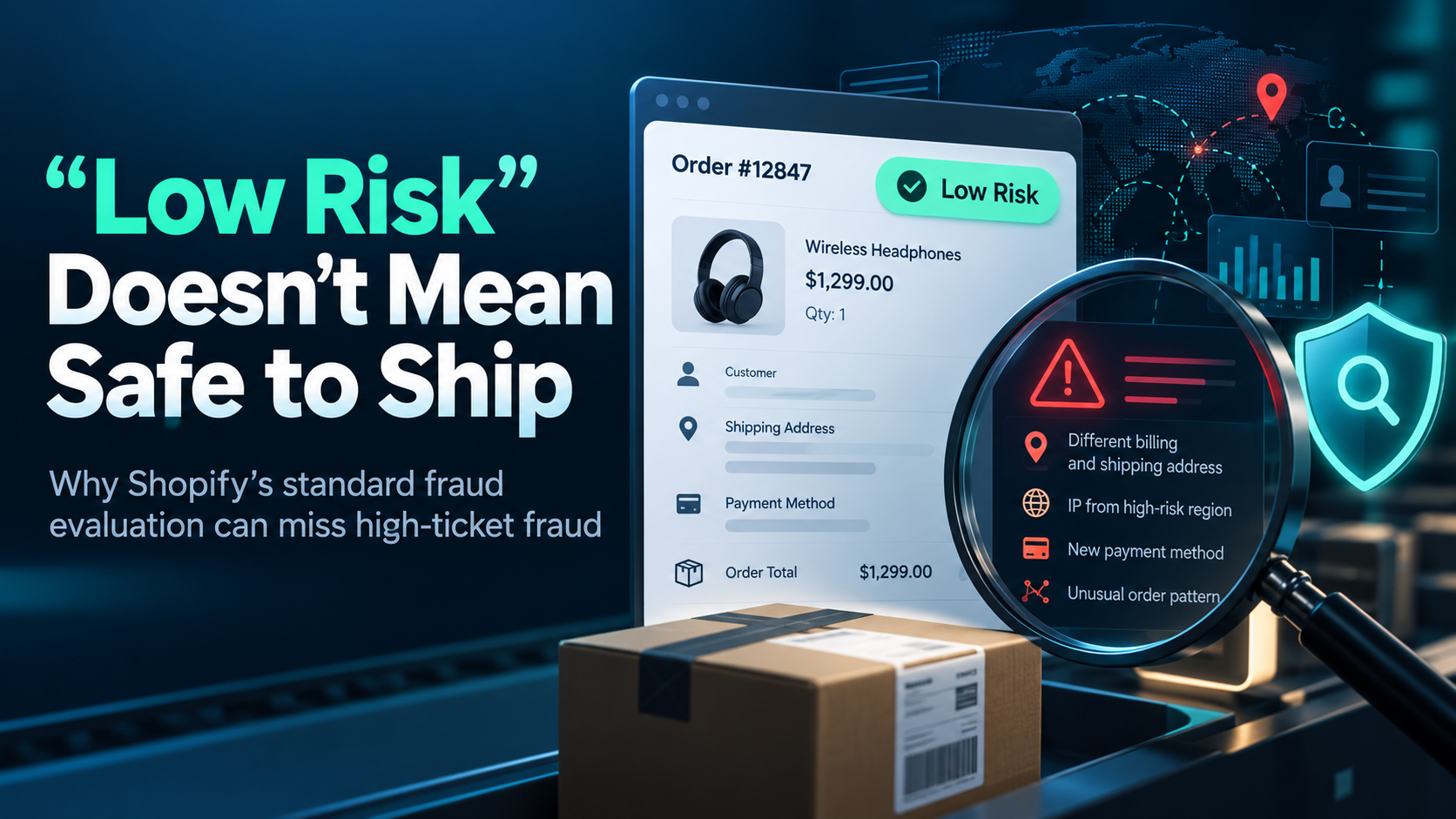
If you run a Shopify store, seeing the words “Low Risk” beside an order is reassuring.
For a $40 order, that may be enough reassurance to ship the product and move on.
But what if the order is worth $2,000, $5,000 or even $10,000?
That changes the equation considerably.
Shopify has built an impressive fraud analysis system. It evaluates orders using multiple signals and provides merchants with a recommendation indicating whether an order presents a low, medium or high risk of fraud.
The problem is that many merchants interpret Low Risk as meaning Safe to Ship.
Those are not the same thing.
Shopify analyzes transactions using machine learning models trained on transaction data across its platform.
Depending on the order, Shopify can evaluate signals including:
AVS and CVV results
Billing and shipping information
Customer location
IP information
Device and network activity
Multiple payment attempts
Other transaction patterns associated with fraud
The resulting risk assessment is extremely useful.
But it is still a risk assessment.
It isn't an identity investigation.
That distinction becomes particularly important when selling expensive physical products.
Imagine an ecommerce store selling electric bikes for $4,500.
A customer places an order and Shopify labels it Low Risk.
The payment clears.
The AVS check passes.
The CVV is correct.
Nothing immediately looks suspicious.
The merchant ships the bike.
Two weeks later, the legitimate cardholder disputes the transaction.
The merchant may now be dealing with the loss of the payment, the product, shipping costs and a chargeback fee.
On a high-ticket order, one mistake can erase the profit from dozens of legitimate sales.
The traditional image of ecommerce fraud is an inexperienced criminal using a stolen credit card and sending an expensive product to an obviously suspicious address.
Modern fraud is often considerably more sophisticated.
Fraudsters can have access to accurate personal information.
They may know the cardholder's:
Full name
Billing address
Phone number
Email information
Date of birth
Other identity details
A transaction can therefore contain many signals that appear legitimate.
The question isn't simply whether the information entered at checkout is technically correct.
The more useful question is:
Does the complete story behind this order make sense?
That requires context.
This is the problem we set out to solve with FRIQ Labs.
Disclosure: I founded FRIQ Labs after dealing with ecommerce fraud firsthand while running my own high-ticket ecommerce business.
Rather than replacing Shopify's fraud analysis, FRIQ adds another layer of investigation.
Every submitted order is reviewed by a trained fraud analyst.
The analyst examines the information available on the order and enriches it using additional data sources to try to establish whether the person placing the order, the payment details and the delivery destination make sense together.
For example, an analyst may investigate questions such as:
Does the billing name actually appear to be associated with the billing address?
Does the phone number belong to the customer?
How long has the email address existed?
Does the shipping recipient have a logical relationship with the purchaser?
Can the recipient be connected to the shipping address?
Does the IP address make sense based on the customer's location?
Is the IP associated with a VPN, proxy, hosting provider or another anonymization service?
If the order is being shipped to a business, does that business actually exist at the address?
Are there inconsistencies that individually seem minor but become suspicious when viewed together?
This is fundamentally different from relying on a single risk score.
Fraud investigations frequently don't produce one enormous red flag.
Instead, they reveal several small inconsistencies.
Consider an order where:
The billing information checks out.
The credit card passes AVS and CVV.
But the shipping address is hundreds of miles away.
The recipient cannot be connected to that address.
The phone number is VoIP.
The IP belongs to a hosting provider.
And the email address appears to have little or no history.
None of those signals necessarily proves fraud.
There may be completely legitimate explanations for every one of them.
But taken together, they justify further investigation before shipping a $6,000 product.
Conversely, an order can initially look suspicious and become reassuring once the relationships are established.
Perhaps the billing customer is buying something for his son.
The different surname belongs to his married daughter.
The shipping address is a second home.
The unusual delivery location is the customer's business.
Good fraud prevention isn't about rejecting anything unusual.
It's about understanding why it's unusual.
This is another weakness of relying too heavily on automated risk classifications.
Stopping fraud is only half the job.
The other half is making sure you don't reject legitimate customers.
A genuine $7,000 order incorrectly canceled because something looked strange is also expensive.
High-ticket merchants therefore face two competing risks:
False negatives: fraudulent orders that are approved and shipped.
False positives: legitimate orders that are canceled because they looked suspicious.
The objective shouldn't be to decline as many questionable transactions as possible.
It should be to make better fulfillment decisions.
That often requires investigation rather than another automated score.
I don't consider Shopify's fraud analysis bad.
Quite the opposite.
It's an excellent first line of defense, and every Shopify merchant should pay attention to it.
But Shopify has to assess an enormous variety of merchants, products, transaction sizes and customer behaviors.
A specialist reviewing a $5,000 order has a different objective.
FRIQ Labs is essentially an outsourced fraud department for high-ticket ecommerce stores.
Instead of giving the merchant more raw data to interpret, the analyst investigates the order and provides an actionable assessment.
The merchant can then decide whether to fulfill the order, investigate further or cancel it.
That distinction becomes increasingly valuable as average order value rises.
If you're selling inexpensive products, accepting a small amount of fraud may simply be part of doing business.
But when individual orders are worth thousands of dollars, the economics are different.
Before shipping, don't just ask:
“Does Shopify say this order is Low Risk?”
Ask:
“If this transaction turns into a chargeback, am I confident I did enough to verify the person behind it?”
For high-ticket ecommerce, that is the standard that matters.
And that is exactly why we built FRIQ Labs.
Learn more about FRIQ Labs and how our manual fraud review service works at FRIQLabs.com.

We're An Affiliate - We are reluctant to allow advertising on this blog, which we believe will spoil the user experience. Instead (so that we can continue sharing our knowledge and expanding our content), we have decided to include affiliate links for the products that we use and/or rate highly.